Got Dried Seaweed? Make Rich Korean Beef Seaweed Soup (Miyeok Guk)
Key Takeaway
With 15 g of dried seaweed and 150 g of beef brisket, you can make a rich and comforting pot of Korean soup in 30 minutes. Sauté in sesame oil, simmer, and season with soup soy sauce.
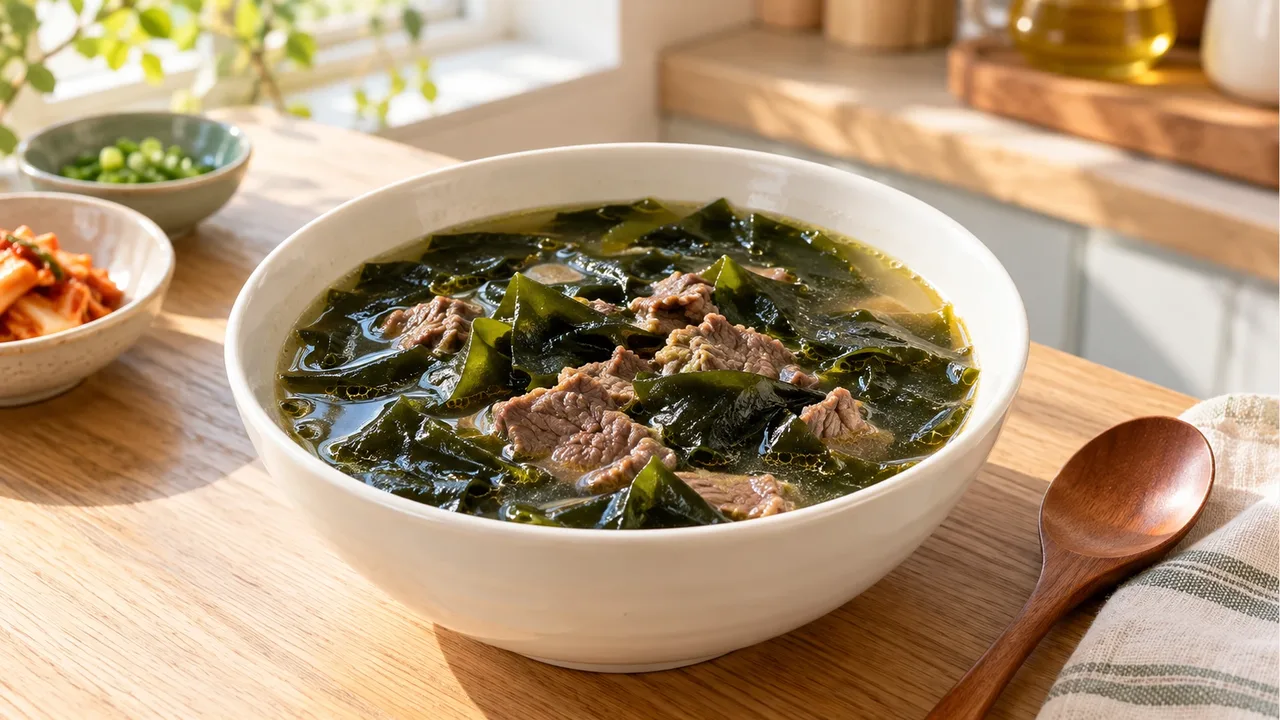
Got dried seaweed? How should you cook it?
If you have dried seaweed as your central ingredient, prepare it like this. First, soak dried seaweed in cold water for 15 minutes to soften it up and cut into bite-sized lengths. Pat excess moisture off the beef with paper towels and lightly season it in advance with soup soy sauce and minced garlic. Drizzle toasted sesame oil in a pot and sauté the seasoned beef first, then add the soaked seaweed and stir-fry for 3 minutes until it turns vibrant deep green. Pour in water, bring to a rapid boil, and reduce the heat to simmer gently for 20 minutes so beef juices and savory seaweed flavors fuse together. Finally, round out the seasoning with fish sauce and salt for a clean, comforting broth.
How much of each ingredient do you need?
Measurement units: a tablespoon (T) means one level Korean table spoon (about 15 ml), and a teaspoon (t) means one standard teaspoon (about 5 ml). The amounts serve four.
| Ingredient | Amount | Substitutes and notes |
|---|---|---|
| Dried seaweed (miyeok) | 15 g | Yields about 150 g once fully rehydrated |
| Beef for soup (brisket) | 150 g | Shank or round can be used if weighed to 150 g |
| Toasted sesame oil | 1 T | Perilla oil can be substituted at 1 T |
| Minced garlic | 1 T | Use 1 t for seasoning beef and 2 t for sautéing |
| Korean soup soy sauce (gukganjang) | 2 T | Use 1 T for seasoning beef and 1 T for the soup |
| Anchovy fish sauce | 1 T | Tuna fish sauce or sand lance sauce works well |
| Coarse salt | 1/2 t | Used to make the final seasoning adjustment |
| Ground black pepper | 1/4 t | Used for seasoning the beef |
| Water | 1500 ml | Rice washing water can be used for added richness |
Dried seaweed weighing 15 g looks small like half a palm when dry, but expands nearly tenfold upon soaking. Measuring dried seaweed with a kitchen scale prevents the soup from becoming unpleasantly crowded or watery.
Why season the beef in advance?
Lightly pat 150 g of beef with paper towels to absorb surface blood, then toss with 1 T soup soy sauce, 1 t minced garlic, and 1/4 t ground black pepper, letting it marinate for 10 minutes. Swirl 1 T sesame oil into the pot when searing the meat, and add the remaining 2 t minced garlic while sautéing the seaweed. Save the remaining 1 T soup soy sauce, 1 T fish sauce, and 1/2 t coarse salt for seasoning during the boiling stage.
Seasoning the beef beforehand allows the saltiness of the soy sauce and aroma of garlic to penetrate deep into meat fibers, ensuring each bite remains flavorful rather than bland. The pre-seasoned coating also protects the beef from scorching while keeping the surface moist during searing. Always keep prep utensils clean and never reintroduce them into seasoning containers.
How do you make it step by step?
- Place 15 g dried seaweed in a wide bowl, pour cold water over it, and let soak for 15 minutes.
- Rinse the rehydrated seaweed twice under running water, drain thoroughly in a colander, and slice into 4 cm pieces.
- Gently press 150 g beef brisket with paper towels to remove surface blood and cut into bite-sized cubes.
- Toss the sliced beef with 1 T soup soy sauce, 1 t minced garlic, and 1/4 t ground black pepper to marinate for 10 minutes.
- Heat 1 T toasted sesame oil in a pot over medium heat, add the marinated beef, and sauté for 2 minutes until the surface is lightly browned.
- Add the sliced seaweed and 2 t minced garlic, sautéing together over medium heat for 3 minutes. Stir-frying until the seaweed deepens to emerald green yields milky broth.
- Pour in 1500 ml of water, turn heat to high, and bring to a rolling boil.
- Skim off foam that surfaces on top with a spoon, cover with a lid, lower heat to medium-low, and simmer gently for 20 minutes.
- Uncover the pot, stir in 1 T soup soy sauce and 1 T anchovy fish sauce, simmer for another 5 minutes, taste, and finish with 1/2 t coarse salt if needed.
What should you watch out for to get rich broth and avoid any gamey aroma?
- Always blot surface blood off the beef first. Blood sticking to the bottom of the hot pan causes murky broth and gamey off-flavors. Do not wash beef in water; gently press dry with paper towels instead.
- Sauté the seaweed thoroughly. Sautéing seaweed in sesame oil and beef drippings for 3 full minutes before adding water softens fibrous cell walls and dissolves umami compounds into the broth.
- Pair soup soy sauce with fish sauce. Relying solely on soup soy sauce turns the broth excessively dark. Using 2 T soup soy sauce for deep base aroma and 1 T fish sauce for savory clarity, followed by salt for the finish, gives the best result.
- Simmer gently over lower heat. Boiling violently over high heat simply evaporates moisture while toughening beef fibers. Once the pot boils, cover and simmer over gentle heat for at least 20 minutes to tenderize meat.
How should you handle raw beef and store leftovers safely?
Raw meat carries risks of cross-contamination, so always use separate cutting boards and knives from those used for fresh produce. Following Ministry of Food and Drug Safety guidelines, wash hands thoroughly with soap for at least 30 seconds after handling raw meats.
Leaving boiled soup at room temperature for extended periods can allow bacteria to multiply. Allow leftover soup to cool slightly, transfer into an airtight container, and store in a refrigerator kept below 5 degrees Celsius. Even under refrigeration, consume within 3 days, and bring the entire pot to a rolling boil for over 3 minutes before serving again.
Frequently Asked Questions
How long should dried seaweed be soaked in cold water?
Dried seaweed softens up nicely after soaking in cold water for 10 to 15 minutes. Soaking for too long reduces its elasticity and makes it overly slimy, so it is best not to exceed 15 minutes.
Can I use ingredients other than beef to make this soup?
You can substitute 200 g of fresh clams, 50 g of dried pollack strips, or a 100 g can of tuna for the beef. Add clams or tuna when the water reaches a rolling boil rather than sautéing them for long beforehand.
How should leftover seaweed soup be stored and reheated?
Cool the soup slightly after cooking, transfer it to an airtight container, and store in a refrigerator below 5 degrees Celsius. Reheat thoroughly for over 3 minutes until the center boils before eating, as recommended by food safety guidelines.