Got Squid? Make Spicy Korean Stir-Fried Squid (Ojingeo-Bokkeum)
Key Takeaway
With 2 squids, you can make a vibrant and comforting Korean main dish in 20 minutes. Slice the vegetables, pre-mix the spicy sauce, and stir-fry rapidly over high heat.
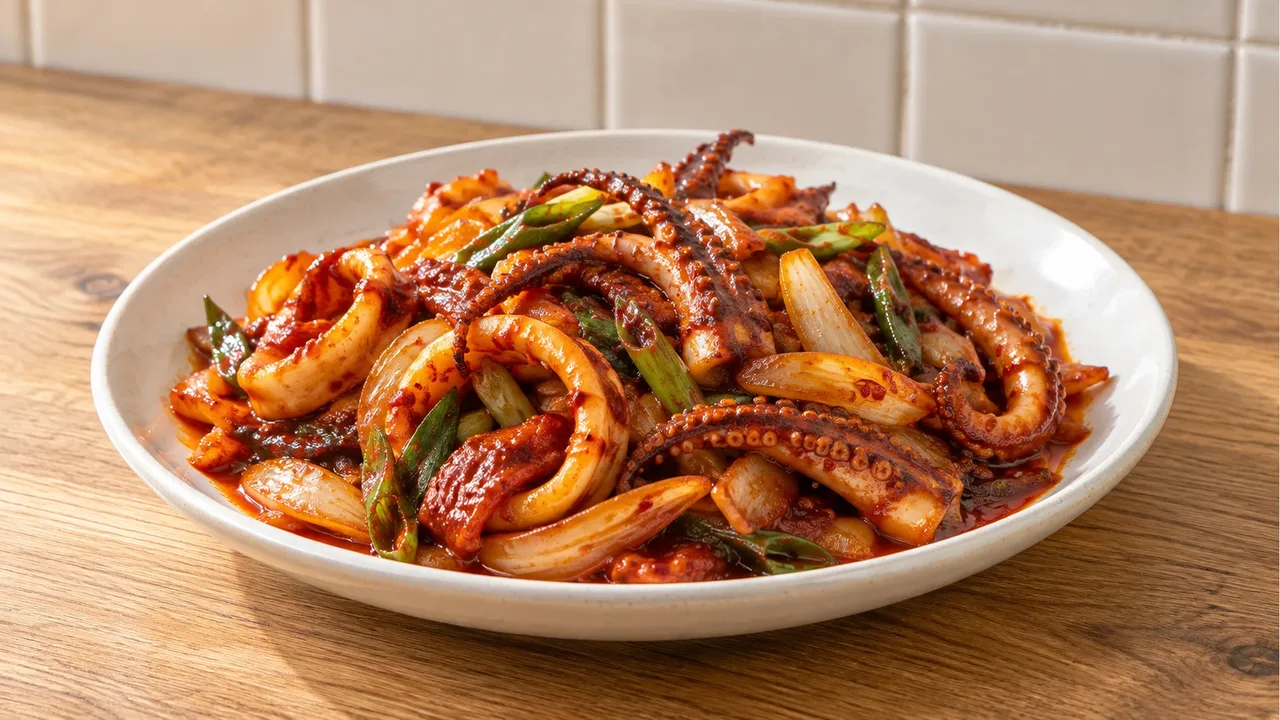
Got squid? How should you cook it?
If you have squid as your central ingredient, prepare it like this. First, clean the squid by removing the innards and quill, score the inner side with a diagonal crosshatch pattern, and cut into bite-sized pieces. Thickly slice cabbage, onion, carrot, and scallions. In a bowl, mix 2 T gochujang, 2 T gochugaru, 2 T soy sauce, 1 T sugar, 1 T oligodang, 1 T minced garlic, 1/2 t minced ginger, and 1 T cooking rice wine until well combined. Heat 2 T cooking oil in a skillet, sauté the firmer vegetables first, then add the prepared squid and sauce together over high heat, stir-frying rapidly for 3 minutes. Finally, swirl in 1 T toasted sesame oil, 1 t toasted sesame seeds, and 1/4 t ground black pepper to complete a glossy, moisture-free spicy stir-fry.
How much of each ingredient do you need?
Measurement units: a tablespoon (T) means one level Korean table spoon (about 15 ml), and a teaspoon (t) means one standard teaspoon (about 5 ml). The amounts serve two to three.
| Ingredient | Amount | Substitutes and notes |
|---|---|---|
| Squid | 2 squids (about 400 g) | Thaw frozen squid thoroughly and pat dry before use |
| Cabbage | 150 g | Add 100 g more onion if cabbage is unavailable |
| Onion | 1/2 (100 g) | Slice thickly to maintain crunchy texture |
| Carrot | 50 g | Slice thinly into half-moons for color |
| Scallions | 1 stalk (60 g) | Cut diagonally and stir-fry with vegetables |
| Cheongyang chili pepper | 1 (10 g) | Substitute with mild green pepper for less heat |
| Red chili pepper | 1 (10 g) | Omit or add 20 g more carrot for color |
| Cooking oil | 2 T | Canola oil or grapeseed oil works well |
| Gochujang (Korean chili paste) | 2 T | Measure level spoonfuls to avoid heavy aftertaste |
| Gochugaru (Korean chili flakes) | 2 T | Provides clean spiciness and vibrant red color |
| Brewed soy sauce | 2 T | Regular dark soy sauce can be substituted |
| Sugar | 1 T | Adds pleasant sweetness and glossy sheen |
| Oligodang (cooking syrup) | 1 T | Corn syrup or rice syrup can be substituted at 1 T |
| Minced garlic | 1 T | Removes seafood odor and enhances deep flavor |
| Minced ginger | 1/2 t | Ginger powder can be substituted at 1/4 t |
| Cooking rice wine (mirin) | 1 T | Cheongju or dry cooking wine works at 1 T |
| Toasted sesame oil | 1 T | Swirl in at the very end after turning off the heat |
| Toasted sesame seeds | 1 t | Crushing seeds lightly between fingers adds aroma |
| Ground black pepper | 1/4 t | Rounds out final flavors and aroma |
Two fresh squids yield approximately 350 g of cleaned meat after removing the innards. Patting the surface dry with paper towels ensures the pan stays hot and prevents hot oil from splattering.
Why mix the sauce in advance?
Combine the sauce ingredients in a small bowl before turning on the stove. Mix 2 T gochujang, 2 T gochugaru, 2 T soy sauce, 1 T sugar, 1 T oligodang, 1 T minced garlic, 1/2 t minced ginger, and 1 T cooking rice wine, stirring with a spoon until the sugar dissolves. Keep 1 T sesame oil, 1 t toasted sesame seeds, and 1/4 t ground black pepper aside, as they are added at the very end of cooking.
Squid becomes tough and releases liquid if cooked for longer than 3 minutes. Adding seasonings one by one directly into the skillet can lead to overcooked squid or burnt seasonings. Preparing the sauce in a single bowl allows you to pour it over the squid all at once and stir-fry quickly over high heat. Always use separate utensils to prevent cross-contamination with raw seafood.
How do you stir-fry it step by step?
- Clean 2 squids by removing innards and cartilage, rinse thoroughly under running water, and pat completely dry with paper towels.
- Score the inner flesh in a 0.5 cm crosshatch pattern, then slice into pieces measuring 1.5 cm wide and 5 cm long.
- Slice 150 g cabbage and 100 g onion into 1 cm strips, and cut 50 g carrot into thin half-moons. Diagonally slice 60 g scallions, 1 Cheongyang chili, and 1 red chili.
- In a small bowl, combine 2 T gochujang, 2 T gochugaru, 2 T soy sauce, 1 T sugar, 1 T oligodang, 1 T minced garlic, 1/2 t minced ginger, and 1 T cooking rice wine to make the sauce.
- Heat 2 T cooking oil in a wide skillet over high heat for 30 seconds, then add the carrots, onions, and cabbage, stir-frying for 1 minute.
- Once the vegetables are lightly coated in oil, add the prepared squid and pre-mixed sauce all at once.
- Keep the heat on high and stir-fry vigorously with a spatula for 2 minutes.
- Add the sliced scallions, Cheongyang chili, and red chili, tossing over high heat for 1 more minute until slightly softened.
- Turn off the stove, drizzle 1 T toasted sesame oil, sprinkle 1 t toasted sesame seeds and 1/4 t black pepper, and toss gently with residual heat to finish.
What should you watch out for to stir-fry over high heat without excess water?
- Thoroughly remove surface moisture with paper towels. Any excess water remaining on the squid causes the skillet temperature to plummet, steaming the squid rather than stir-frying it. Press firmly with paper towels even after scoring the flesh.
- Cook quickly over maximum heat. Stir-frying over medium or low heat shrinks the squid muscle fibers, forcing out flavorful juices and creating a pool of liquid. Maintain high heat throughout and keep total cooking time under 4 minutes to preserve a tender, bouncy bite.
- Pre-mix the sauce before cooking. Adding seasonings individually wastes precious seconds, giving water time to leak out of the vegetables and squid. Pouring the combined sauce together with the squid ensures instant clinging without heat loss.
- Always add sesame oil after turning off the heat. Sautéing sesame oil over high heat destroys its delicate roasted fragrance and can introduce bitterness. Tossing it off the flame allows residual heat to coat the entire dish with a warm, nutty aroma.
How should squid be prepped and leftover food stored?
To prevent food poisoning bacteria such as Vibrio parahaemolyticus from multiplying on raw squid, remove innards promptly and rinse the meat thoroughly under clean running tap water. Keep cutting boards and knives used for raw seafood strictly separated from fresh vegetable boards. In accordance with food safety guidelines, wash your hands thoroughly with soap under running water for at least 30 seconds after handling raw squid.
Cook squid until heat penetrates to the center, heating above 85 degrees Celsius for at least 1 minute. Cooked stir-fry spoils easily if left at room temperature, so let leftovers cool slightly, transfer to an airtight container, and store in a refrigerator below 5 degrees Celsius. Follow food safety recommendations by consuming refrigerated leftovers within 2 days, and reheat in a skillet above 85 degrees Celsius for 2 to 3 minutes until steaming hot throughout before eating.
Frequently Asked Questions
How can I prevent too much water from gathering in the pan?
Score the inner flesh with a crosshatch pattern and thoroughly pat off excess moisture with paper towels. Heat the pan over high heat, pour in the sauce all at once, and stir-fry rapidly within 3 minutes to lock in moisture.
What is the safest way to thaw frozen squid?
Avoid leaving it out at room temperature; thaw it slowly in the refrigerator the day before, or place it sealed in a plastic bag submerged in cold water. Rinse briefly under cold running water and dry completely before cooking.
How should leftover stir-fried squid be stored and reheated?
Cool slightly after cooking, transfer to an airtight container, and store in a refrigerator below 5 degrees Celsius for up to 2 days. Reheat in a dry skillet over high heat for 2 to 3 minutes until steaming hot throughout.